Customer Story
Greenwell Farms: How a Kona coffee family built a crew that comes back every season

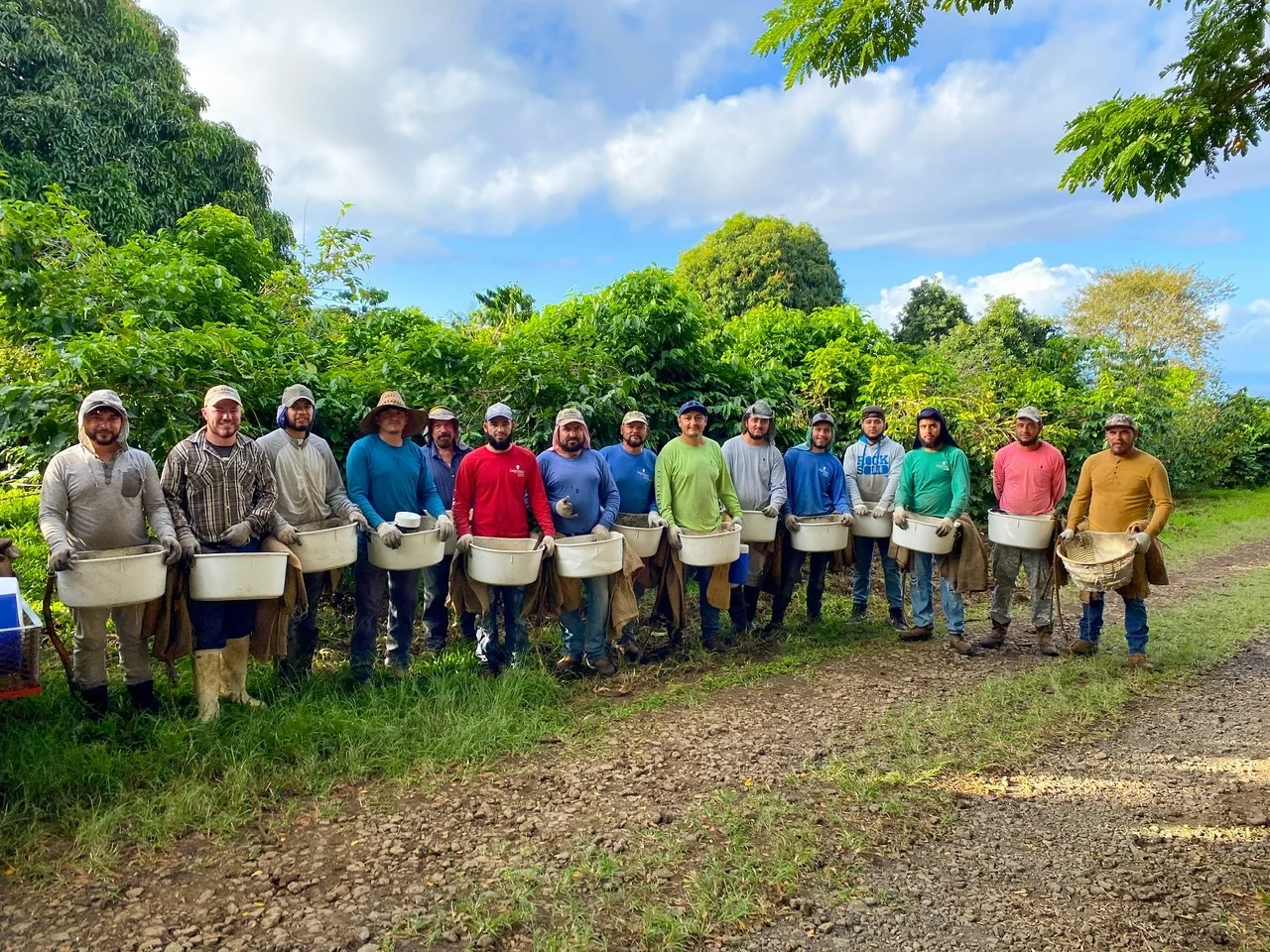
Greenwell Farms has grown coffee in Kona for four generations. Today the farm brings in 42 H-2A workers each harvest, and Seso helps keep the program running smoothly. Here's how CEO and President Tom Greenwell got there.
Four Generations in Kona
Greenwell Farms' story goes back to 1850, when Tom's great-grandfather began buying land in Kona, on Hawaii's Big Island. He became a coffee exporter, shipping Kona coffee to the West Coast and around the world.
He also carried Hawaii's crops to the world's fairs. At the 1873 fair in Vienna, Austria, he showed coffee, sugar cane, cotton and more. "They were trying to grow all kinds of stuff in Hawaii at that time," Tom says.
Over the years the family added sheep, then cattle. Tom, the fourth generation, grew up working the family ranch.
From cattle to coffee
Around 1985, the cattle business stopped paying. Tom's uncle sold the ranch, but his father held on to some very good ag land and started growing coffee.
"Going from cattle to coffee, very different," Tom says. "He kind of forced me to work with him. I was forced labor, put it that way." The two surrounded themselves with the smartest coffee growers and processors in Kona.
What hooked Tom was his father's plan to build a mechanical coffee harvester. By 1991 and 1992, their trials were working. Then his father passed away in 1992, and Tom had to run the business.
As coffee prices climbed, every ripe bean left on the tree cost money. Tom shelved the harvester and went all in on hand harvesting, processing and building the Greenwell name. With his brother-in-law, he grew the farm from 20 acres to about 200.
"It takes every single bean off the tree to make it a go." — Tom, Greenwell Farms

More than coffee
Today Greenwell Farms buys coffee from about 250 other Kona farmers and distributes roasted coffee worldwide. Every bean in Kona is picked by hand. "Most of the farms are like five acres," Tom says. "You can't really do it mechanically."
The farm runs tours seven days a week, and visitors leave with more than coffee. Tom is considered the only black pepper farmer in the United States. It started when employees from Micronesia brought him pepper from home. "It was just so amazing," he says. "I couldn't believe I would get excited over some black pepper."
A few vines became a garden, then a crop the tourists love. Greenwell also grows cacao for chocolate bars made with local partners, plus avocados, oranges, tangerines and lychee. No more cattle, though.
The year one picker showed up
As the Big Island became a tourist destination, hotel and infrastructure construction pulled workers away from the coffee fields. Finding pickers got harder every year.
"They would hear down the road somebody's getting two cents more a pound, and they would all of a sudden be gone," Tom says. "They'd be here today and gone tomorrow."
Greenwell built some of the first ag housing in Hawaii in years, designed around the H-2A program. Then the 2009 economic crash hit. About 65 applicants showed up 45 days before harvest, mostly looking for signatures for their unemployment cards. Because of those applicants, the farm's first H-2A application was denied.
"When they came to start picking coffee, there was one person out there." — Tom, Greenwell Farms
That stressful season made the decision for them. After a slow recovery, Greenwell brought in its first H-2A workers around 2013, managing the program with help from a lawyer.
Straight and narrow
Running H-2A on their own, the team realized a few times that they had been doing things wrong. Nothing was intentional, and no one was shortchanged. It was the little things in a complicated program, like which taxes apply and what H-2A workers are and aren't entitled to. Even their local payroll company struggled with the details.
That's when Greenwell brought on Seso. "It's actually been a great time ever since, and really a lot of help," Tom says. "It relieves the pressure a lot."
Seso handles visas, consulate scheduling and travel logistics, getting workers across the border and to Kona smoothly. "There are so many people, boots on the ground, doing the logistics that we can't possibly handle ourselves," Tom says.
Just as valuable is the training. Seso explains what needs to be done and why, so the team understands the rules instead of guessing at them. Tom credits CSM Alma Aguilar and attorney Barron Dickinson by name: "The team that we have with Alma and Barron are incredible."
"Seso basically keeps us straight and narrow. It's very complicated to hire H-2A and run it correctly, and Seso has been the biggest help I could ever imagine." — Tom, Greenwell Farms
Two crews, one tropical season
Kona's harvest starts slow, peaks in October and runs from late September into November. Greenwell grows coffee at every elevation, so some fields ripen well after others.
To match that rhythm, Greenwell runs two overlapping H-2A crews. Some workers don't want to be away from home for eight months, so they choose a shorter contract. A second crew stays longer, from mid-September through January or February.
That second crew does the work that sets up next year's crop: pruning and getting the farm back in shape after harvest. "You can't hire enough experts in Kona to help you with that," Tom says. "We train them, and we don't have to tell them what to do anymore."
The weather doesn't make it easy. A season can start a month and a half early or a month and a half late. "The federal government likes to have it start on the same day every year and end on the same day every year," Tom says. "They don't understand tropical weather."
With Seso, Greenwell can stagger workers in and out as the crop dictates. When rules change, Seso tells them right away what they can use in their favor. Tom also points to Seso's webinars on topics like the new AEWR wage rates: "Anytime requirements for big things change, they've always got a lot of information coming out to us. We love that."
From the consulate to the time clock
Before workers land in Kona, the office team has to load every one of them into the farm's payroll system. Seso's consulate tab shows exactly where each worker stands.
"I can see who has finished what paperwork, where we're at with the schedule, when we're going to have them hitting the farm, their interviews, the border crossing," the team says. "All that information is so helpful for inputting it into our payroll company."
Digital onboarding and E-Verify close the last gap. Greenwell once tracked worker hours on spreadsheets while waiting for new-hire paperwork to clear. Now, because Seso has already completed E-Verify, workers are set up on the time clock before their first day.
"We get them onto the time clock now before they even start work. It's wonderful." — Greenwell Farms office team
Professionals who come back
Greenwell's first H-2A application was for 16 workers. Today the farm brings in 42, and Tom expects to need 47 or 48 to keep up with harvest.
Many of those workers return year after year. Some have been coming for about 10 years. "As our guys keep coming back every year, they become very professional at what they're doing," Tom says. "Our quality standards are very high, and they meet them."
"These guys want to come back again next year, so they do the best job they can. Being able to get the same guys every year is fantastic." — Tom, Greenwell Farms
If you want to learn more about Greenwell Farms, read how Seso’s legal team won their 2024 H-2A appeal after the Department of Labor questioned whether a Kona coffee harvest is really seasonal.
Join the hundreds of farms and FLCs who support their workers with Seso