›
Legal Affairs Counsel’s Corner: Proposed OMB Rule Would Expand Mandatory E-Verify to Federal Grant Recipients

Legal Affairs Counsel’s Corner: Proposed OMB Rule Would Expand Mandatory E-Verify to Federal Grant Recipients
By Barron Dickinson
Proposed OMB Rule Could Significantly Expand Mandatory E-Verify Requirements for Federal Grant Recipients
The White House Office of Management and Budget (OMB) has proposed a rule that could substantially expand mandatory participation in E-Verify beyond federal contractors. Under the proposal, all recipients and subrecipients of Federal financial assistance would be required to participate in E-Verify for employees and contractors hired in or performing work in the United States under a covered federal award. The full text of the proposed rule is available in the Federal Register: Regulation for Federal Financial Assistance (Proposed Rule).
For agricultural employers, this proposal could have far-reaching implications. While participation in the H-2A program alone would not trigger the requirement, many growers, ranches, cooperatives, and agribusinesses receive USDA financial assistance through grants, cooperative agreements, disaster assistance, conservation programs, and certain other federally funded initiatives. Those employers could become subject to mandatory E-Verify as a condition of receiving federal funds.
One notable aspect of the proposal is that OMB does not define "subrecipient" for purposes of this new requirement, leaving uncertainty as to how broadly the requirement could ultimately be applied. Under existing federal grant rules, many vendors and contractors are not considered subrecipients. However, the proposed rule separately references employees and contractors performing work under a Federal award, creating uncertainty regarding whether certain downstream service providers could ultimately be required to participate in E-Verify through future agency guidance or implementation.
For example, a grower receiving a USDA disaster recovery grant to restore orchards following a hurricane may hire a farm labor contractor to provide crews for debris removal, irrigation repairs, or replanting. While the farm labor contractor would not ordinarily be considered a subrecipient solely because it was hired by the grower, the proposal leaves unanswered whether contractors performing federally funded work could ultimately become subject to the E-Verify requirement. This issue will likely require clarification before the rule is finalized.
Importantly, OMB included several express limitations intended to narrow the scope of the proposal. The agency states that the E-Verify requirement would apply only to employees and contractors hired in or performing work under a Federal award and would not extend to activities unrelated to the Federal award. OMB also emphasizes that it is not proposing to alter existing DHS E-Verify requirements, exceptions, or limitations, but rather to incorporate E-Verify into the internal control requirements applicable to recipients and subrecipients of federal financial assistance. According to OMB, the purpose of the proposal is to strengthen compliance with existing federal employment eligibility laws and help ensure that individuals performing work funded by federal awards are authorized to work in the United States. While these assurances should provide comfort to many employers, questions remain regarding how agencies will distinguish between covered and non-covered activities and whether certain downstream contractors or service providers could ultimately become subject to the requirement.
Although still in the proposed stage, this rule would represent one of the most significant expansions of mandatory E-Verify participation in years. Agricultural employers, farm labor contractors, and other agribusinesses that receive—or perform work funded by—USDA financial assistance should monitor this rulemaking closely and consider evaluating their current E-Verify compliance practices in anticipation of potential changes.
USCIS Clarifies English Language Evidence Requirements for H-2A Commercial Drivers
U.S. Citizenship and Immigration Services (USCIS) has issued new guidance clarifying how employers must demonstrate English language proficiency for H-2A workers who will operate commercial motor vehicles (CMVs) in positions requiring a commercial driver's license (CDL). The updated guidance follows President Trump's Executive Order 14286 directing federal agencies to strengthen English language proficiency standards for commercial vehicle operators and subsequent guidance issued by the U.S. Department of Labor (DOL). The new USCIS guidance is available here: USCIS Alert – H-2A Temporary Agricultural Workers.
Effective June 15, 2026, DOL requires employers seeking permanent or temporary labor certifications for positions involving the operation of commercial motor vehicles to include an English language proficiency requirement in the job opportunity. As a result, H-2A employers filing for workers who will operate CMVs must generally submit evidence that each beneficiary satisfies that requirement.
USCIS states that acceptable evidence of English language proficiency may include:
Documentation showing the worker passed a standardized English language examination;
A signed statement from the employer attesting that the employer knows the worker possesses the required level of English language proficiency; or
For workers issued H-2A visas after June 15, 2026, the visa itself. USCIS announced that, because the U.S. Department of State has implemented enhanced English language screening and vetting for visa applicants who will operate commercial motor vehicles, it will accept qualifying visas issued after June 15, 2026, as evidence that the worker satisfies the English language requirement.
Importantly, rather than obtaining separate testing records or preparing employer attestations, USCIS’s guidance advises petitioners that they may generally rely on a qualifying H-2A visa issued after June 15, 2026, when filing Form I-129 for commercial driver positions.
Employers should note that this guidance applies only to H-2A positions requiring operation of a commercial motor vehicle where the underlying labor certification includes an English language proficiency requirement. Employers should continue to ensure that all workers meet any applicable CDL licensing, medical certification, and other federal or state qualifications required for the position.
For additional background on the Executive Order and DOL's implementation guidance, see Seso's prior blog post, OFLC Publishes FAQ Regarding English Language Proficiency Requirements in Job Orders Seeking to Employ Operators of Commercial Motor Vehicles.
DOL Delays Publication of 2026-2027 H-2A Adverse Effect Wage Rates
As of today, the U.S. Department of Labor (DOL) has still yet to release its annual update to H-2A Adverse Effect Wage Rates (AEWRs) for 2026-2027, despite the release of the necessary data by Occupational Employment Wage Statistics (OEWS) and Housing and Urban Development (HUD) data, and DOL’s pledge in its 2025 Interim Final Rule to follow the July 1 schedule. While DOL has not provided an explanation for the delay, Seso currently expects the updated AEWRs to be published within the next several weeks.
A possible explanation for the delay might be attributed to DOL’s publication of its forthcoming Final Rule regarding the new AEWR methodology it originally introduced via its 2025 IFR in October 2025. According to publicly available information reflected on the Office of Information and Regulatory Affairs’ (OIRA) website, DOL is still expected to release its Final Rule on an unspecified date during July 2026 as reflected the timetable below:
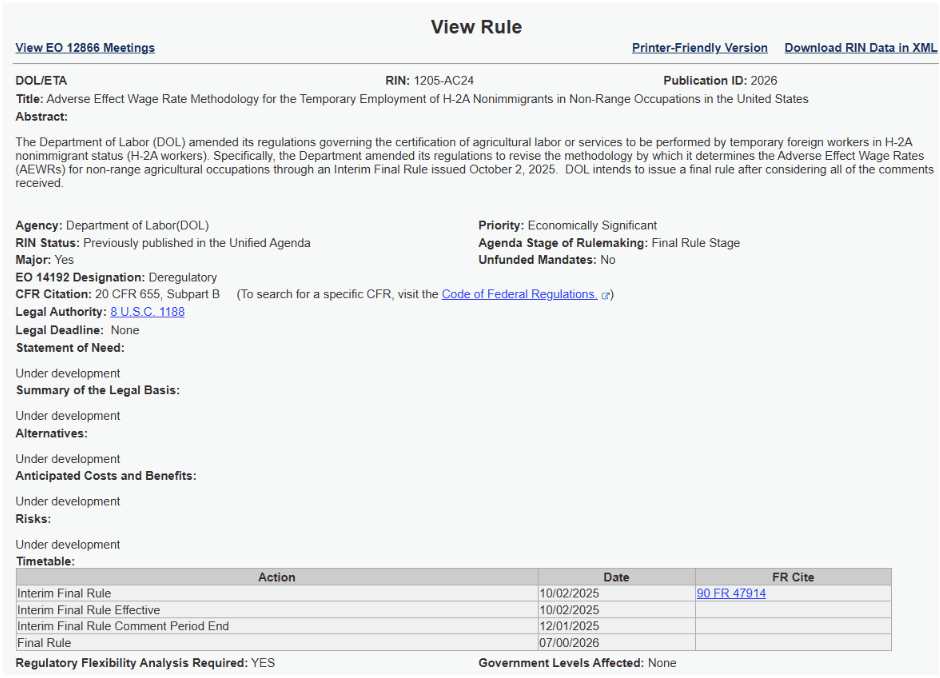
Until new rates are officially published, employers should continue paying the currently applicable AEWR in effect for their state and occupation. Employers are not required to begin paying anticipated new wage rates before the DOL publishes the updated AEWRs in the Federal Register.
Employers should also be mindful of the H-2A mid-contract wage adjustment requirements. Under 20 C.F.R. § 655.120, if DOL publishes an updated AEWR during the work contract and the new AEWR is higher than the highest applicable wage previously in effect—including the prior AEWR, any applicable prevailing wage, collectively bargained wage, federal minimum wage, or state minimum wage—the employer must begin paying at least the updated AEWR beginning on the date the updated AEWR is published in the Federal Register. Conversely, if the updated AEWR is lower than the wage rate guaranteed on the certified job order, the employer must continue paying at least the higher guaranteed job order wage for the remainder of the work contract and may not reduce workers' wages mid-contract.
More broadly, 20 C.F.R. § 655.120 requires H-2A employers to offer, advertise, and pay the highest applicable wage rate, which may be: (1) the AEWR; (2) the prevailing wage rate; (3) the agreed-upon collective bargaining wage; (4) the federal minimum wage; or (5) the state minimum wage. Accordingly, employers should continue monitoring state minimum wage increases and prevailing wage determinations, which may be issued or updated at any time and can affect H-2A wage obligations independently of the annual AEWR publication.
Seso is actively monitoring the situation and will notify clients immediately after the new AEWRs are published, including a state-by-state summary of any wage changes, the effective dates, and guidance regarding any required mid-contract wage adjustments.
DOL OIG Announces Major Visa Fraud Investigation—What H-2A and H-2B Employers Should Know
On July 8, 2026, the U.S. Department of Labor's Office of Inspector General (OIG) announced a new nationwide enforcement initiative targeting fraud, labor trafficking, and worker exploitation in employment-based visa programs. While the announcement specifically identifies the H-1B and PERM programs as the initial focus of the investigation, H-2A and H-2B employers should view it as another clear signal that federal agencies are increasing scrutiny of all temporary foreign worker programs and the labor brokers, recruiters, and employers that participate in them. A copy of the press release is available here: DOL OIG Launces Investigation into H-1B Visa Fraud and Human Trafficking to Protect American Workers
Although the OIG's announcement does not create any new legal obligations for H-2A or H-2B employers, it reinforces the Administration's broader enforcement priorities, including combating visa fraud, labor trafficking, fraudulent recruitment practices, wage kickbacks, and other forms of worker exploitation. Employers that rely on third-party recruiters, foreign labor contractors, or staffing intermediaries should ensure they are conducting appropriate due diligence and maintaining documentation demonstrating compliance with program requirements.
For H-2A and H-2B employers, now is an appropriate time to review recruitment practices, confirm that workers have not paid prohibited recruitment or placement fees, verify that wages and working conditions match certified job orders, and ensure all required records are complete and readily available in the event of an audit or investigation. Employers should also periodically evaluate the compliance practices of any agents, recruiters, or labor contractors acting on their behalf, as government investigators continue to focus on the entire recruitment chain rather than only the petitioning employer.
While the latest announcement is directed primarily at H-1B and PERM fraud, it reflects an unmistakable trend toward increased enforcement across all employment-based immigration programs. Employers that proactively audit their compliance programs and work with reputable partners will be best positioned as federal enforcement activity continues to expand.
Congress Introduces Bipartisan CRAW Act to Expand H-2A Eligibility for Crawfish Processing
A bipartisan group of Louisiana lawmakers has introduced the Crawfish Reclassification for Agricultural Workforce (CRAW) Act, legislation that would amend the Immigration and Nationality Act (INA) to classify crawfish processing as "agricultural labor or services" for purposes of the H-2A visa program. The bill was introduced by Representatives Troy Carter (D-LA), Clay Higgins (R-LA), and Cleo Fields (D-LA).
If enacted, the CRAW Act would amend the Immigration and Nationality Act (INA) to expressly include activities such as washing, sorting, grading, whole-boiling, peeling, and transporting crawfish within the definition of agricultural labor or services. By codifying these activities as agricultural labor, crawfish processors would become eligible to utilize the H-2A program rather than relying on the H-2B program, which remains subject to the annual statutory visa cap. The full text of the bill is available here: CRAW Act Bill Text.
The legislation follows significant labor shortages experienced during the 2026 crawfish season, when many processors were unable to secure sufficient H-2B workers after the visa cap was reached. Industry leaders reported that processing facilities were forced to reduce operations, while some crawfish were shipped overseas for processing due to labor shortages. Supporters of the legislation note that Louisiana's crawfish industry now generates more than $640 million annually and argue that access to the uncapped H-2A program would provide a more stable and reliable seasonal workforce.
The CRAW Act also complements the broader Securing Agriculture's Workforce Act (SAWA), recently introduced by House Agriculture Committee Chairman G.T. Thompson. As discussed in Seso's prior analysis, SAWA would modernize the H-2A program through comprehensive reforms, including expanding eligibility to additional agricultural industries with year-round labor needs, creating a more predictable wage methodology, streamlining program administration, and designating H-2A workers as essential. While SAWA proposes broad structural reforms to the H-2A program, the CRAW Act takes a more targeted approach by expressly extending H-2A eligibility to crawfish processing. Together, these legislative efforts reflect growing bipartisan recognition that the H-2A program should better align with the labor needs of modern American agriculture. For additional background on SAWA and its proposed reforms, see Seso's prior blog post: Securing Agriculture's Workforce Act Overview.
The bill has been referred to the House Judiciary Committee for consideration. Seso will continue monitoring the legislation and provide updates as it advances through Congress.
Categories: Legal
Share this article
No previous articles.
No newer articles.
Disclaimer: The information provided on this blog is for general informational purposes only. All information on the site is provided in good faith, however, we make no representation or warranty of any kind, express or implied, regarding the accuracy, adequacy, validity, reliability, availability, or completeness of any information on the site. Under no circumstance shall we have any liability to you for any loss or damage of any kind incurred as a result of the use of the site or reliance on any information provided on the site. Your use of the site and your reliance on any information on the site is solely at your own risk.
The blog may contain links to other websites or content belonging to or originating from third parties or links to websites and features in banners or other advertising. Such external links are not investigated, monitored, or checked for accuracy, adequacy, validity, reliability, availability, or completeness by us. We do not warrant, endorse, guarantee, or assume responsibility for the accuracy or reliability of any information offered by third-party websites linked through the site or any website or feature linked in any banner or other advertising. We will not be a party to or in any way be responsible for monitoring any transaction between you and third-party providers of products or services.
Ready to learn more?