
Legal Affairs Counsel’s Corner: Updated H-2A AEWR for Herding and Range Livestock Workers
This month's key policy updates for H-2A and ag employers.
By Barron Dickinson
Seso's Barron Dickinson breaks down key policy updates for January 2026.
DOL Announces Updated H-2A AEWR for Herding and Range Livestock Workers Effective February 3, 2026
On January 20, 2026, the U.S. Department of Labor’s Office of Foreign Labor Certification (DOL) announced it had published a Federal Register Notice announcing an updated Adverse Effect Wage Rate (AEWR) for H-2A workers engaged in the herding or production of livestock on the range. The updated national monthly AEWR will take effect on February 3, 2026.
For range livestock occupations, DOL continues to apply a monthly wage rate in recognition of the unique nature of range work. As a reminder, under DOL’s 2015 H-2A Range Rule, employers must offer, advertise in recruitment, and pay each worker employed under a range job order the highest applicable wage in effect during the covered period of employment, including the monthly AEWR, collective bargaining wage wage, federal/state minimum wage, or any other rate the employer intends to pay. See 80 FR 62958 (Oct. 16, 2015), 20 CFR 655.210(g). Further, when the monthly AEWR is adjusted during an active work contract, and the adjusted AEWR represents the highest applicable wage of the foregoing list of wage sources, employers must pay at least that adjusted monthly AEWR upon publication by DOL in the Federal Register. See 655.211(a)(2). However, employers are permitted to prorate the wage for the initial and final pay periods of the job order period if their pay period does not match the beginning or ending dates of the job order or if a worker is voluntarily unavailable to work for personal reasons. See 655.210(g)(3).
New Monthly AEWR for Range Livestock Occupations
Effective February 3, 2026, the national monthly AEWR for herding or production of livestock on the range is $2,132.41 per month. This rate reflects a 3.6 percent increase over the prior year and is based on the Bureau of Labor Statistics Employment Cost Index, consistent with the methodology set forth in the H-2A regulations.
Immediate Action Items for H-2A Range Employers
H-2A employers with range livestock operations should take proactive steps to ensure compliance with the updated wage requirement:
Review and update all pre- and post-cert H-2A job orders and recruitment materials to confirm that the offered wage meets or exceeds the new monthly AEWR for range livestock work.
Adjust payroll practices so that any work performed on or after February 3, 2026 is compensated at no less than the updated monthly AEWR, unless a higher applicable wage rate applies.
Coordinate with your H-2A filing agent and/or facilitators on pending or upcoming H-2A applications, particularly where the period of employment spans the February 3 effective date.
Maintain clear documentation demonstrating timely updates to wage offers, recruitment materials, and payroll systems in the event of a DOL audit or investigation.
Additional Information
The full Federal Register Notice announcing the updated AEWR for herding or production of livestock on the range is available here.
The updated AEWR is also reflected on the Department of Labor’s Foreign Labor Application Gateway (FLAG) wage data page available here.
Employers who currently utilize Seso’s managed payroll services will have their payroll updated automatically. Should you have any questions or concerns regarding DOL’s announcement, please do not hesitate to contact your assigned Seso representative.
State Department Announces New Requirements for Mexican CDL Heavy Truck Drivers
The State Department recently issued the following update below to all H-2 agents registered with Mission Mexico regarding new requirements for H-2A workers who will be employed under a job order assigned the SOC Code of 53-3032-Heavy and Tractor-Trailer Truck Drivers that includes a CDL requirement:
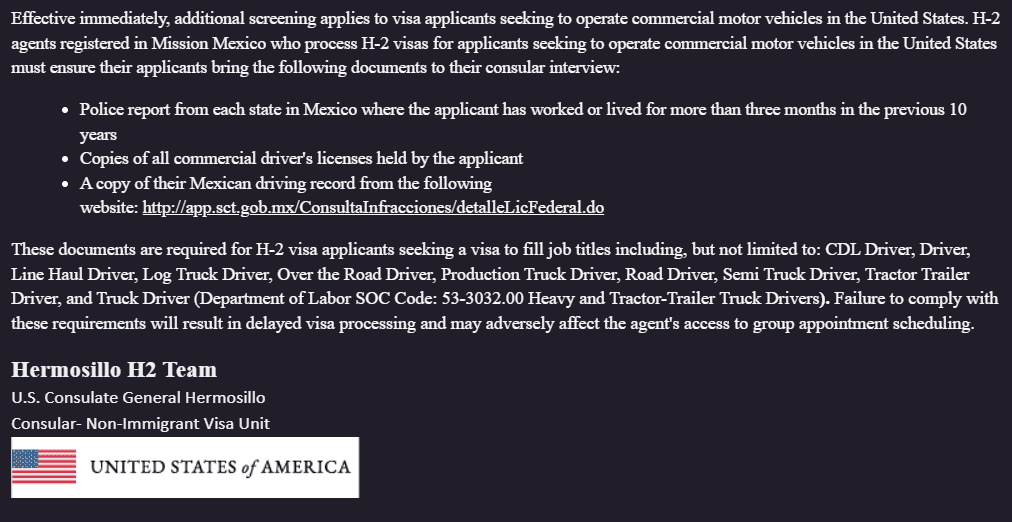
As of today, it is our understanding that these new requirements are limited to only 53-3032 job orders reflecting a CDL requirement as a job qualification. Further, the background check report should be limited to Mexican states (not U.S. states) where the worker has “worked or lived for more than three months in the previous 10 years.”
Our WorkerOps team in Mexico has already initiated a new process for assisting H-2A workers with gathering the required information in advance of traveling to their assigned U.S. consulate in Mexico for issuance of their visas. In terms of allocation of the cost of completing the required background check, we are advising employers to plan on reimbursing workers as part of their established reimbursement process for the purpose of avoiding potential FLSA issues. Employers with in process job orders at DOL (pre-cert) should plan on disclosing these new requirements in their job orders to ensure workers are apprised of all material terms and conditions of employment.
Lastly, we have been advised by NCAE that their leadership is currently in the process of seeking clarification from the State Department regarding these new requirements. To date, no formal or informal rulemaking has been initiated based on our research.
We will keep you apprised of any further updates in this regard as they become available. Should you have any questions in the interim, please do not hesitate to contact your CSM or a member of our in-house legal team.
Sun Valley’s Reach Tested as H-2A and H-2B Employers Press Jury-Trial Challenges Nationwide
The Third Circuit’s landmark decision in Sun Valley Orchards, LLC v. U.S. Department of Labor—now final with no further appeals pending—continues to reverberate across the country as employers challenge the Department of Labor’s use of administrative tribunals to adjudicate H-2A and H-2B enforcement actions. Recent decisions from the Department of Labor’s Office of Administrative Law Judges (OALJ), along with a pending federal court motion in South Carolina, illustrate how courts and agencies outside the Third Circuit are grappling with Sun Valley’s implications.
In December 2025, an Administrative Law Judge (ALJ) in Wage and Hour Division v. Triple R Farms LLC rejected an H-2A employer’s demand for a jury trial, concluding that Sun Valley does not bind cases arising outside the Third Circuit and that administrative law judges lack authority to declare the INA or its implementing regulations unconstitutional. While acknowledging Sun Valley’s holding that certain H-2A enforcement actions resemble common-law breach-of-contract claims, the ALJ emphasized that—absent controlling circuit precedent—the administrative process must continue as written.
A similar result followed in January 2026 in Administrator v. RSG Landscaping LLC, an H-2B enforcement matter arising in the Fourth Circuit. There, the Chief ALJ again denied a jury-trial demand, reaffirming that Sun Valley is not binding outside the Third Circuit and that OALJ proceedings must proceed under existing regulations unless and until a federal appellate court holds otherwise.
At the same time, employers are increasingly taking Sun Valley arguments directly to federal court. In Del Valle Fresh, Inc. v. U.S. Department of Labor, an H-2A employer has asked a federal district court in South Carolina to halt an ongoing DOL administrative enforcement action, seeking a temporary restraining order and preliminary injunction . Relying heavily on Sun Valley and the Supreme Court’s decision in SEC v. Jarkesy, the employer argued that DOL’s pursuit of back wages and civil money penalties must be adjudicated in an Article III court with a jury, and that forcing the employer to proceed before an ALJ causes irreparable constitutional harm.
Taken together, these developments show that while Sun Valley is settled law within the Third Circuit, its broader national impact remains unresolved. OALJ is continuing to apply existing H-2A and H-2B enforcement frameworks outside that circuit, even as employers increasingly seek federal court intervention. Whether other circuits will ultimately adopt Sun Valley’s reasoning—or whether the Supreme Court will be asked to resolve the growing split—remains one of the most closely watched issues in H-2A and H-2B enforcement nationwide.
UFW Challenges DOL’s New AEWR Methodology: What H-2A Employers Need to Know
United Farm Workers (“UFW”) has filed a federal lawsuit in the U.S. District Court for the Eastern District of California seeking to block the U.S. Department of Labor’s (DOL) October 2025 Interim Final Rule (IFR) that updates how the Adverse Effect Wage Rate (AEWR) is calculated for H-2A and corresponding U.S. workers. The suit asks the court to halt the IFR nationwide, but it is important for H-2A employers to understand that this case is fundamentally a policy dispute over how best to balance worker protections with labor market realities and agricultural competitiveness.
The DOL IFR was promulgated to replace the long-criticized USDA Farm Labor Survey (FLS) wage data with a new methodology based on the Bureau of Labor Statistics’ Occupational Employment and Wage Statistics (OEWS) data, skill-based wage tiers, and a housing value adjustment. This new approach addresses inherent flaws in the prior system that often produced AEWRs significantly above local market rates and far above what employers actually pay for comparable labor. By using broader, occupation-specific OEWS data and accounting for the inherent costs associated with employing H-2A workers, including employer-provided housing, the rule aligns wage obligations more closely with real agricultural labor markets and helps stabilize labor costs for employers competing in tight, high-cost labor environments.
As reflected in its pending Motion for Stay and Preliminary Injunction, UFW argues that the IFR will reduce wages, but that position overlooks the practical realities facing agricultural employers nationwide. The prior AEWR methodology has been widely criticized for inflating wage rates to levels disconnected from actual labor market conditions, contributing to higher production costs and increased pressure on growers already operating with thin margins. The updated rule reflects a more nuanced, data-driven approach that supports continued domestic agricultural production while maintaining statutory worker protections.
Anticipated Timeline for Resolution
The court has entered a Stipulated Briefing Schedule on UFW’s motion for a stay and preliminary injunction. DOL’s opposition brief is due January 22, 2026, and UFW’s reply brief is due February 5, 2026. After the reply is filed, the motion will be taken under submission, meaning no hearing is currently scheduled unless the court later determines that oral argument is warranted. While timing can vary, employers should generally expect a ruling weeks—not months—after briefing is complete, potentially in late February or March 2026, absent an extension to the current briefing schedule in place.
NCAE Plans to Support DOL’s New AEWR Rule with Amicus Brief
In addition to DOL’s defense of the IFR, the National Council of Agricultural Employers (NCAE) has announced plans to file an amicus curiae brief in support of the rule. Amicus participation from employer organizations provides the court with important real-world context regarding labor availability, compliance challenges, and the economic impacts of AEWR volatility on agricultural operations. NCAE’s involvement is indicative of broad industry support for retaining the updated methodology by employers, and we applaud their efforts.
Takeaways for Employers
Importantly, the alternative to the IFR is not a return to a stable, historic AEWR framework. The USDA has discontinued the FLS, and without a modern replacement methodology, employers face continued uncertainty and the risk of outdated or unworkable wage calculations. Notably, UFW has offered no solutions to replace the current methodology either. DOL’s reliance on OEWS data offers a forward-looking solution intended to provide predictability and consistency in H-2A wage setting.
At this time, the IFR remains in effect. Employers should continue to comply with current AEWR requirements in their H-2A applications and payroll practices unless and until a court of competent jurisdiction orders otherwise. Seso is closely monitoring this litigation and will continue to keep employers informed of any developments that could affect H-2A compliance, labor budgeting, or operational planning.
Categories: Legal
Share this article
No previous articles.
No newer articles.
Disclaimer: The information provided on this blog is for general informational purposes only. All information on the site is provided in good faith, however, we make no representation or warranty of any kind, express or implied, regarding the accuracy, adequacy, validity, reliability, availability, or completeness of any information on the site. Under no circumstance shall we have any liability to you for any loss or damage of any kind incurred as a result of the use of the site or reliance on any information provided on the site. Your use of the site and your reliance on any information on the site is solely at your own risk.
The blog may contain links to other websites or content belonging to or originating from third parties or links to websites and features in banners or other advertising. Such external links are not investigated, monitored, or checked for accuracy, adequacy, validity, reliability, availability, or completeness by us. We do not warrant, endorse, guarantee, or assume responsibility for the accuracy or reliability of any information offered by third-party websites linked through the site or any website or feature linked in any banner or other advertising. We will not be a party to or in any way be responsible for monitoring any transaction between you and third-party providers of products or services.
Ready to learn more?