
New H-2A AEWRs Are Here: What Agricultural Employers Need to Know
por Daniel Ross
The U.S. Department of Labor (DOL) has published the updated Adverse Effect Wage Rates (AEWRs) for the 2026–2027 period. The new rates were announced in the Federal Register (91 FR 48946) and take effect immediately for most states, with the exception of the 17 states covered by the litigation in Kansas et al. v. U.S. Department of Labor, in which they take effect on 08/17/2026.
Quick Background
The AEWR is the wage floor designed to ensure that hiring foreign workers under the H-2A program does not adversely affect the wages of similarly employed U.S. workers. DOL’s uses skill-based, occupation-specific survey data to calculate , and rates are now based on data from Bureau of Labor Statistics Occupational Employment and Wage Statistics (OEWS) and published at two tiers for entry-level and experienced Skill Level.
For H-2A workers, each rate is then reduced by a state-specific H-2A Adverse Compensation Adjustment — a downward, housing-related factor based on HUD fair market rents for a four-bedroom unit — producing a distinct, lower H-2A rate.
The vast majority of H-2A hiring falls in the field and livestock worker category — the five standard agricultural occupations often referred to as the “Big 5” (graders and sorters; agricultural equipment operators; farmworkers and laborers, crop; farmworkers, farm and ranch animals; and hand packers and packagers). These jobs are paid at the statewide field-and-livestock AEWR. All other, non-Big-5 occupations are paid at their own occupation-specific rate.
New AEWR's
All new AEWR’s can be downloaded here at the official DOL link: View the statewide 2026-2027 IFR AEWRs
For a simple comparison of Big Five and Non-Big-Five Wage Rates:

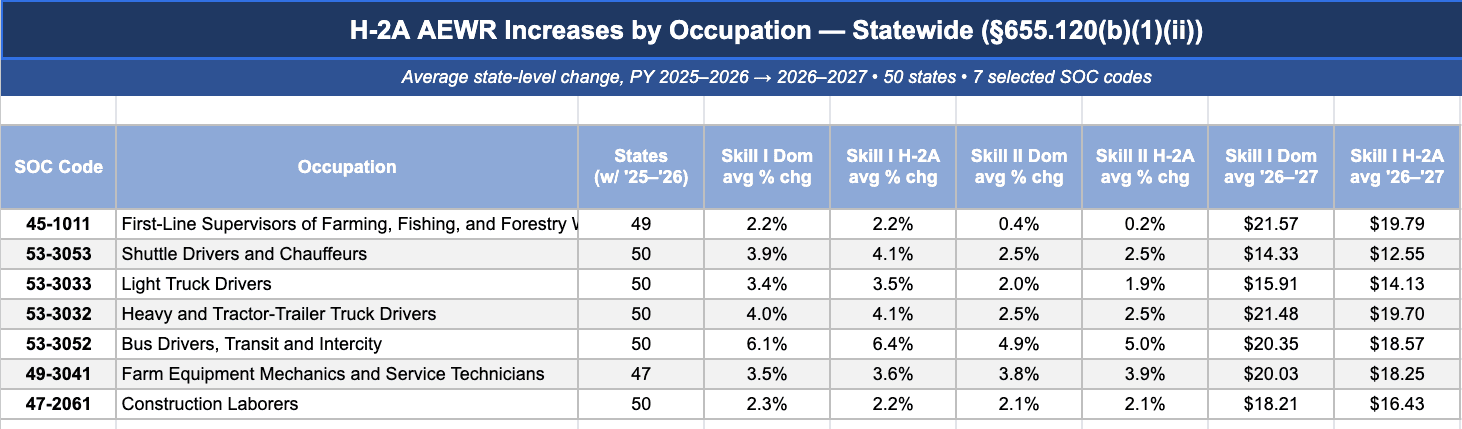
For a filtered view of frequent non-Big-Five SOC Code Wage Rates:
Reminder of Wage Obligations
H-2A employers must pay each worker the highest of the applicable AEWR, the prevailing wage, the agreed-upon collective bargaining wage, the federal minimum wage, or the state minimum wage. In states with minimum wages that exceed the AEWR, the state minimum wage will be the effective wage rate.
If a wage guarantee in an existing, approved job order is higher than the new AEWR, that higher guaranteed wage generally continues to apply for the remainder of that job order. Conversely, when the new AEWR is higher than the rate currently being paid, employers must raise pay to the new AEWR as of the effective date. Wages can increase during an H-2A contract, but they can never decrease. Employers should verify the correct rate for each state and occupation on their contracts, update payroll accordingly, and document the change.
In states with minimum wage statutes not exempting agricultural labor, the state minimum wage is often the effective wage floor for H-2A employers. Common examples of the state minimum wage continuing to control for Skill I H-2A workers include (but not limited to) the following examples:
Sampling of states where minimum wage exceeds Skill I AEWR:
Arizona ($15.15 state minimum wage vs. $13.13 AEWR H-2A Skill I)
California ($16.90 state minimum wage vs. $13.52 AEWR H-2A Skill I)
Colorado ($15.16 state minimum wage vs. $14.51 AEWR H-2A Skill I)
Florida ($15 state minimum wage on 09/30/26 vs. $10.87 AEWR H-2A Skill I)
Illinois ($15 state minimum wage vs. $14.01 AEWR H-2A Skill I)
Michigan ($13.73 state minimum wage vs. $13.06 AEWR H-2A Skill I)
New York ($16 state minimum wage vs. $13.62 AEWR H-2A Skill I)
Oregon ($15.05 state minimum wage vs. $13.00 AEWR H-2A Skill I)
Washington $17.13 state minimum wage vs. $14.49 AEWR H-2A Skill I)
Surety Bond Rate Decrease
For the Big-Five categories, the nationwide average AEWR is now $15.96 per hour, and this is the new figure DOL will use to calculate H-2A labor contractor surety bond amounts. New calculations for surety bonds, effective immediately, can be found here, and employers should seek surety bonds in the new, reduced amounts for any upcoming contracts:
Amount of Workers | Base Amount | Bond Multiplier | Bond Multiplier 2 | Groups of 50 over 100 | Final Bond Amount |
|---|---|---|---|---|---|
< 25 | $5,000 | $8,627.03 | N/A | $8,627.03 | |
25-49 | $10,000 | $17,254.05 | N/A | $17,254.05 | |
50-74 | $20,000 | $34,508.11 | N/A | $34,508.11 | |
75-99 | $50,000 | $86,270.27 | N/A | $86,270.27 | |
100-149 | $75,000 | $129,405.41 | N/A | $129,405.41 | |
150-199 | $75,000 | $129,405.41 | $193,245.41 | 1 | $193,245.41 |
200-249 | $75,000 | $129,405.41 | $257,085.41 | 2 | $257,085.41 |
250-299 | $75,000 | $129,405.41 | $320,925.41 | 3 | $320,925.41 |
300-349 | $75,000 | $129,405.41 | $384,765.41 | 4 | $384,765.41 |
350-399 | $75,000 | $129,405.41 | $448,605.41 | 5 | $448,605.41 |
400-449 | $75,000 | $129,405.41 | $512,445.41 | 6 | $512,445.41 |
450-499 | $75,000 | $129,405.41 | $576,285.41 | 7 | $576,285.41 |
500-549 | $75,000 | $129,405.41 | $640,125.41 | 8 | $640,125.41 |
550-599 | $75,000 | $129,405.41 | $703,965.41 | 9 | $703,965.41 |
600-649 | $75,000 | $129,405.41 | $767,805.41 | 10 | $767,805.41 |
650-699 | $75,000 | $129,405.41 | $831,645.41 | 11 | $831,645.41 |
700-749 | $75,000 | $129,405.41 | $895,485.41 | 12 | $895,485.41 |
750-799 | $75,000 | $129,405.41 | $959,325.41 | 13 | $959,325.41 |
800-849 | $75,000 | $129,405.41 | $1,023,165.41 | 14 | $1,023,165.41 |
850-899 | $75,000 | $129,405.41 | $1,087,005.41 | 15 | $1,087,005.41 |
900-949 | $75,000 | $129,405.41 | $1,150,845.41 | 16 | $1,150,845.41 |
950-999 | $75,000 | $129,405.41 | $1,214,685.41 | 17 | $1,214,685.41 |
1000-1049 | $75,000 | $129,405.41 | $1,278,525.41 | 18 | $1,278,525.41 |
1050-1100 | $75,000 | $129,405.41 | $1,342,365.41 | 19 | $1,342,365.41 |
When are the new rates effective?
The updated AEWRs take effect August 3, 2026 for most states. A slightly later effective date of August 17, 2026 applies to the 17 states covered by the 2024 court ruling in Kansas et al. v. U.S. Department of Labor:
Arkansas
Florida
Georgia
Idaho
Indiana
Iowa
Kansas
Louisiana
Missouri
Montana
Nebraska
North Dakota
Oklahoma
South Carolina
Tennessee
Texas
Virginia
Overall Trend
Year over year, entry-level H-2A field-and-livestock rates rose modestly in 41 states and territories and declined in 13, with an average increase of roughly 3.7%. While still an overall increase in the previous year’s wages, the growth rate is substantially more favorable for employers than the previous AEWR methodology (prior to the IFR on 10/02/2025), which relied on the USDA’s Farm Labor Survey results.
Three midwestern states saw the most dramatic growth in entry-level Big-5 H-2A wages, driven primarily by wage increases in the hand packers and packagers sector. As a result, these states saw Skill I H-2A increases as follows:
Kansas from $11.43 to $13.86 (+21.3%)
Nebraska from $12.96 to$14.91 (+15%)
North Dakota from $11.04 to $12.94 (+17.2%)
Several states saw minor decreases in effective H-2A wage rates, with Indiana, for example, moving from $13.66 to $13.52. Employers in such states with decreases should immediately seek to amend job orders to the new, lower wage rates in order to avoid certification at the old rates.
Join Seso and Fisher Phillips on Wednesday, August 5th for a rundown of what the new AEWR rates could mean for your operation with live Q&A.
Categorías: Legal
Compartir este artículo
No hay artículos anteriores.
No hay artículos más recientes.
Aviso legal: La información proporcionada en este blog es solo para fines informativos generales. Toda la información en el sitio se proporciona de buena fe, sin embargo, no hacemos representación o garantía de ningún tipo, expresa o implícita, con respecto a la exactitud, adecuación, validez, confiabilidad, disponibilidad o integridad de cualquier información en el sitio. En ningún caso tendremos responsabilidad hacia usted por cualquier tipo de pérdida o daño incurrido como resultado del uso del sitio o la confianza en cualquier información proporcionada en el sitio. Su uso del sitio y su confianza en cualquier información en el sitio es únicamente bajo su propio riesgo.
El blog puede contener enlaces a otros sitios web o contenido perteneciente u originado por terceros o enlaces a sitios web y características en banners u otra publicidad. Tales enlaces externos no son investigados, monitoreados o verificados por nosotros en cuanto a su exactitud, adecuación, validez, confiabilidad, disponibilidad o integridad. No garantizamos, respaldamos, garantizamos o asumimos la responsabilidad de la exactitud o confiabilidad de cualquier información ofrecida por sitios web de terceros enlazados a través del sitio o cualquier sitio web o característica enlazada en cualquier banner u otra publicidad. No seremos parte o de ninguna manera seremos responsables de monitorear cualquier transacción entre usted y proveedores de productos o servicios de terceros.
¿Listo para aprender más?