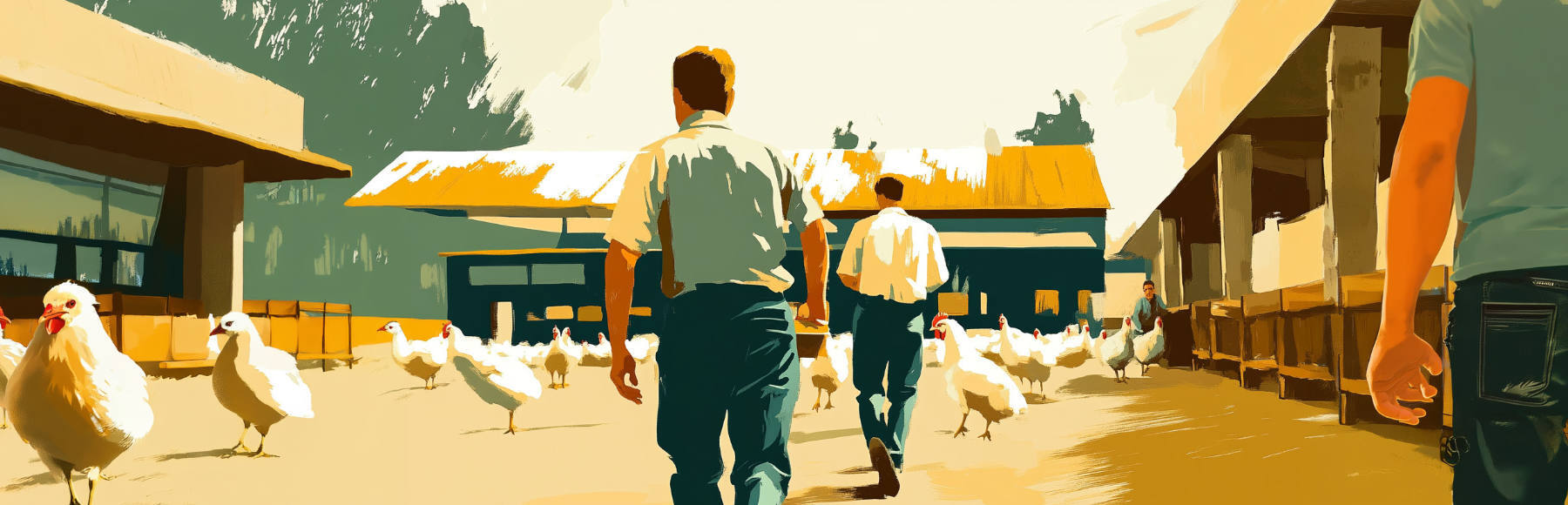
How Hubbard Breeders Built a TN Visa Program that now Anchors their Operation
A four-year case study in solving rural agricultural labor shortages with skilled, professional international workers
por Brandi Knox
When Hubbard Breeders, the New Hampshire-based pedigree poultry operation that's part of the global Aviagen Group, first considered a TN visa program four years ago, they were nearly 50% understaffed. They had cycled through temp agencies and local contract labor, with the kind of revolving-door turnover that costs more in training and biosecurity risk than the labor itself was worth. Today, the TN visa program is, in the words of their Director of Operations, "literally the backbone of my operation."
This post walks through how they got there: the pilot decision, the risks they weighed, what they learned, and what the program looks like now with more than 40 TN workers in place. It's drawn from a recent webinar conversation with Chris Malcolm, Director of Operations at Hubbard LLC, and Ian Real, a hatchery manager who joined Hubbard on a TN visa four years ago and has since been promoted into multiple roles.
A Quick Refresher on TN
Before getting into Hubbard's story, let us offer a brief refresher of the program. The TN visa is a work visa based on the trade treaty between the U.S., Mexico, and Canada. Appendix D of the treaty lists 69 professional classifications eligible for TN status, of which roughly 11 to 15 apply to agriculture, both on-farm operational roles and front-of-house roles like accounting.
A few features that make TN well-suited to ag employers:
the visa is good for 3 years and can be renewed indefinitely
there's no DOL pre-approval and no USCIS pre-filing, so processing is fast
there's no rigid wage formula like the AEWR, just FLSA compliance
and TN workers can stay year-round rather than being limited to a 10-month season.
For employers already running an H-2A program, anything you're already willing to provide H-2A workers, like housing or transportation, becomes a fringe benefit on top of the TN wage, which gives you flexibility on base salary while presenting a competitive total package.
The other key point: TN workers come with degrees in their field. They can supervise, manage, and take on the broader scope of duties that fall within their professional classification, things H-2A doesn't permit.
Why Hubbard Started Looking Beyond Local Recruiting
Hubbard is a primary breeder, one of three pedigree operations within the Aviagen Group (alongside sites in Scotland and Tennessee). They handle a significant portion of the larger group's R&D. They breed chickens, collect data, and operate without artificial insemination, focusing on genetics and producing the parent stock that gets distributed globally.
The labor challenge had two dimensions. First, the New Hampshire site is rural, so the local labor pool is thin. Second, the work is physically demanding and animal-focused, and Chris noted what many ag employers have been observing: younger generations are largely uninterested in working with animals. As a result, Hubbard struggled both to find people and to keep the people they found.
That's particularly costly in poultry, where biosecurity is paramount. As Chris put it, every job, no matter how routine, carries the potential for catastrophic consequences if done incorrectly. A single contamination event can mean millions of dollars lost as flocks have to be euthanized. So every dollar spent training someone who then leaves is a dollar at risk twice: once on the wasted training itself, and again on the heightened error exposure of constantly onboarding new people.
The Pilot Decision
The first cohort was small, 15 TN workers, and the decision-making was driven by a few specific factors:
The candidates come with degrees. For Hubbard, this wasn't just about finding hands at the farm. As an R&D operation, they needed skilled and technical workers. The TN classification requirement (a bachelor's degree or, in two classifications, an associate's plus relevant experience) meant the candidate pool was already at the level they actually needed to hire into.
The commitment is self-selecting. Chris emphasized this point repeatedly. The willingness to relocate to another country signals something real about a candidate's drive. "That's showing me commitment right out the gate," he said. It doesn't guarantee anything, but it's a meaningful signal compared to local recruiting where someone might show up because the job is the closest one to their house.
The math worked. Yes, there's an upfront cost to bringing in international workers, particularly when housing is part of the package. But Hubbard had already been spending heavily on temp agencies and local recruiting that produced turnover instead of retention. Comparing that ongoing waste to a one-time investment in a more durable workforce made the financial case relatively clean.
How quickly they decided to expand: almost immediately. Chris said the majority of the first cohort stayed and the majority were happy, so as soon as they had additional housing capacity available, they began filling it.
The Risks They Weighed (and Are Still Weighing)
Chris was candid about the discussions that happened internally, both during the pilot and at every stage of expansion since.
The financial piece was the most visible concern. Bringing in international workers carries a higher upfront cost than local recruiting, even when local recruiting has been failing. Building the case required showing leadership that the cost of doing nothing, the perpetual turnover and recruiting churn, was higher.
Policy and political risk came up too. There's always concern that immigration policy could shift quickly and create disruption. Hubbard has continued to invest in the program despite that uncertainty, on the view that the work has to get done either way.
On the housing front, providing housing means taking on a degree of responsibility for people's day-to-day living conditions, including the inevitability of interpersonal friction when groups of people share homes. Hubbard has had its share of those situations and has found success treating them as a normal part of the program rather than a reason to step away from it.
Some workers don't stay. A handful of TN workers have completed two years and chosen to return home to their families. That's a fully understandable outcome, and it doesn't change the value of the program. As Chris noted, "we would have those same challenges with somebody who just walked in off the street, right? We're human beings."
The Outcomes
Over the last 18 months, Hubbard has overhauled their management team and work structure in New Hampshire, and the people anchoring that overhaul came in through the TN program. They've moved from "we need hands" to "the people running our operation came through this program."
One pattern Hubbard has observed is what Brandi described as a kind of game theory effect on the broader workforce. The TN workers arrived with high energy and a strong work ethic, and over time the U.S. workforce began to mirror that standard. The new normal got reset upward.
Because Hubbard sits inside the Aviagen Group, several TN workers have found additional opportunities at other locations within the organization. That mobility is part of what makes the program attractive to candidates, and Hubbard sees it as a feature rather than a loss, since it strengthens the broader Aviagen system.
A Worker's Perspective: Ian's Story
Ian Real joined Hubbard four years ago as a TN visa holder. He's an agronomist by training, was working in the same industry in Mexico, and was specifically looking for career growth that he didn't see a path to at home.
On the TN process itself, his experience was straightforward. "Honestly, I didn't do anything," he said. Seso handled the paperwork, the interview prep, the bus tickets, the hotel rooms, the flight tickets. He showed up, completed his consular interview, and arrived in New Hampshire ready to start.
What surprised him about Hubbard? He expected a large global organization to feel impersonal. Instead, he described it as feeling more like a family business, a tone he credited to the way the company actually treats people once they arrive.
He shared about his transition into R&D work. Ian had worked in poultry in Mexico, but on the production side. Coming into a research and development environment was a step up in technical complexity. He described being struck by how much process exists behind every task, how many specialized tools are used, and how that contrasted with the more improvisational version of similar work he'd done before.
Ian also touched on the personal transition for him: moving to a new country where you don't know anyone or the culture is hard. Ian noted that what made it easier was that Hubbard didn't bring him alone. They hired multiple people from Mexico in the same period, which let a small community form and made it easier to integrate into both the company and the broader U.S. environment.
When it comes to career growth, Ian shines. He has been promoted multiple times. Sometimes he applied because he saw an opportunity he wanted; sometimes management approached him because they saw a fit. Both happened, and both are signals of how the program functions when it's working well.
His advice to employers considering it: "Once you take the risk to bring TN visa workers, we are more than eager to demonstrate what we are capable of. If you give them a chance, you won't regret it."
What Hubbard Would Tell Other Employers
Be very clear and transparent about expectations up front. This was Chris's biggest takeaway from four years in. People are uprooting their lives to take these jobs. The clearer you can be about what the work actually involves, what the living situation looks like, what the trajectory could be, the better the program performs and the lower the risk of losing people early. Hubbard has gotten better at this over time, and it directly improves both retention and worker satisfaction.
Provide housing and transportation if you can. Hubbard provides both for the first two years. The reasoning was simple: people relocating from another country to a remote area are going to perform better if they have those amenities readily available rather than having to figure them out on top of starting a new job in a new country. Ian confirmed the worker side of that calculus, noting that not having to manage the apartment search at the same time as starting a new role allowed him to focus entirely on the job. After two years, workers transition to finding their own housing.
Trust the recruiting and screening process so you can focus on selection. Hubbard's interview protocols for TN candidates are essentially the same as for any other hire. What changed was the quality of the candidate flow they were interviewing. Chris noted that having a partner handle the recruiting legwork meant interview time wasn't wasted on unqualified candidates, which made the process feel efficient even at scale.
Expect human issues, because they're human beings. A small number of TN hires haven't worked out, for the same reasons that local hires sometimes don't. Some left after two years because they missed their families. A small number had non-paperwork legal issues. None of that has changed Hubbard's overall view of the program, because the same range of outcomes exists in any hiring channel.
The Current State of the Program
Hubbard is now operating with more than 40 TN workers and continues to expand. Chris was direct about where this could go: "Possibly being fully staffed with all folks that are coming in from other countries. And if that's the reality, then it is what it is, and we need to lean into it." The work is finite, recurring, and has to get done. The local labor pool isn't growing. The TN program has earned the confidence of leadership over four years of results, which is what makes ongoing expansion an easier conversation than it was at the start.
The Bottom Line
Hubbard's experience is a useful reference point for any agricultural employer thinking about whether a TN program could work for their operation. The pattern is one we see repeatedly: a labor shortage that has resisted years of local recruiting effort, a willingness to make a measured upfront investment in a different approach, and a small pilot that produces enough success to make expansion the obvious next step. The result is a workforce of skilled, degreed professionals who can hold critical roles, stay year-round, and provide the kind of operational continuity that a constantly turning local workforce simply cannot.
The TN program isn't a replacement for H-2A and isn't right for every role on every farm. It's a complement, sitting alongside H-2A and other specialty visa programs in a layered labor strategy. For the higher-skilled, year-round, professional roles that H-2A isn't built for, it's one of the most accessible options agricultural employers have, and Hubbard's program is proof of how durable the results can be.
Watch the full webinar with Chris Malcolm, Ian Real, and Brandi Knox, including the Q&A, here.
Want to talk through what a TN program could look like for your operation? Get in touch with Seso →
Nothing in this post constitutes legal advice. Visa eligibility is fact-specific. Consult a licensed immigration attorney for guidance on your situation.
Categorías: Legal
Compartir este artículo
No hay artículos anteriores.
No hay artículos más recientes.
Aviso legal: La información proporcionada en este blog es solo para fines informativos generales. Toda la información en el sitio se proporciona de buena fe, sin embargo, no hacemos representación o garantía de ningún tipo, expresa o implícita, con respecto a la exactitud, adecuación, validez, confiabilidad, disponibilidad o integridad de cualquier información en el sitio. En ningún caso tendremos responsabilidad hacia usted por cualquier tipo de pérdida o daño incurrido como resultado del uso del sitio o la confianza en cualquier información proporcionada en el sitio. Su uso del sitio y su confianza en cualquier información en el sitio es únicamente bajo su propio riesgo.
El blog puede contener enlaces a otros sitios web o contenido perteneciente u originado por terceros o enlaces a sitios web y características en banners u otra publicidad. Tales enlaces externos no son investigados, monitoreados o verificados por nosotros en cuanto a su exactitud, adecuación, validez, confiabilidad, disponibilidad o integridad. No garantizamos, respaldamos, garantizamos o asumimos la responsabilidad de la exactitud o confiabilidad de cualquier información ofrecida por sitios web de terceros enlazados a través del sitio o cualquier sitio web o característica enlazada en cualquier banner u otra publicidad. No seremos parte o de ninguna manera seremos responsables de monitorear cualquier transacción entre usted y proveedores de productos o servicios de terceros.
¿Listo para aprender más?