Customer Story
Hays Harvesting: How a mother-daughter team rebuilt their back office

From an orange grove, one grower at a time
The story starts with citrus. Anne Marie Hays’s grandfather worked for Ocean Spray, and her father was raised in the middle of an orange grove — the same grove where she grew up.
“Agriculture’s always been in my Dad’s blood,” she says. He started out on his own, and in 1983 Anne Marie’s parents and her grandfather formally incorporated Hays Harvesting.
It began small and stayed focused on citrus harvesting for years. In the beginning, her mother kept the company’s books while working full time at Indian River Community College and attending graduate school, while her father built the business the only way he knew how: one customer at a time, one grower at a time. “It’s been a family effort since the beginning,” Anne Marie says.
More than four decades later, Hays Harvesting serves growers across Central Florida through the H-2A program.
Farm labor contracting used to come with a tidy division of risk — a grower hired an FLC and the liability sat firmly with the contractor. That arrangement has been quietly dissolving for years.
“It is shifting so dynamically that we have found ourselves as true partners with growers,” she says, helping them navigate what she considers the most complex part of farming: finding and keeping a dependable workforce in a regulatory environment that changes underneath you.
Most of the growers Hays serves are multi-generational family operations wrestling with the same rising costs and the same family dynamics, which is part of why the relationships hold. “We have really become extensions of their operations.”
A career that chose her
That continuity nearly ended. In late 2023 and early 2024 the company reached a major crossroads, and Anne Marie stepped in to help her family through a hard stretch. She had grown up in agriculture, but she had spent 25 years building a career as a speech pathologist, and she assumed the detour would be brief and temporary. It became neither.
“No one expects a midlife career change,” she says. “But looking back, from the perspective of where we are now — I didn’t choose this career as much as I think it chose me.”
Her daughter, Lacey Nail, came home from college that summer to help. Almost finished with her bachelor’s degree in accounting, Lacey moved her final internship from Gainesville to the accounting firm Hays Harvesting had worked with for many years.
What emerged was a partnership built around two very different, but remarkably complementary, strengths. Lacey brought her accounting background and took on the financial side of the business—an area Anne Marie readily admits was never her strength.
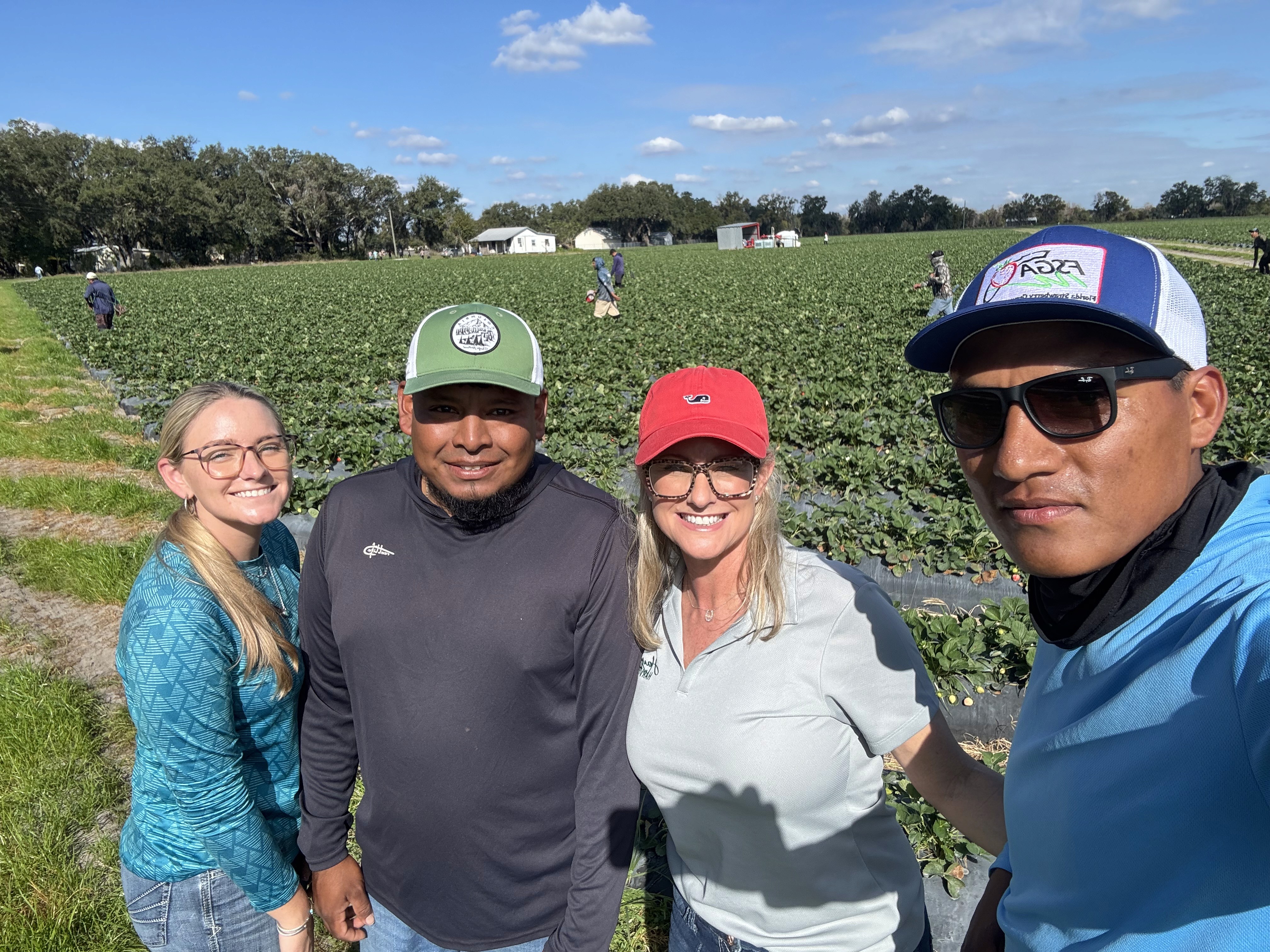
Left to right it is Lacey Nail, Rodrigo Escandon Vidal, Anne Marie Hays, Edgar Rodriguez Paredes (both H2A workers and eventually drivers that have been with Hays Havesting for 6 seasons)
Anne Marie brought something different: Twenty-five years in healthcare and education had left her fluent in precisely the kind of environment H-2A demands.
“I’ve always been able to adapt, bring order to complex situations, and navigate highly regulated environments. I had to have a very deep understanding of federal regulations and state statutes,” she says.
“I understood compliance before I ever stepped foot in Hays Harvesting’s office.”
Once it became clear this was more than closing out a season and shutting the doors, that there was a legacy worth continuing, “it just made sense that we would do this together.”
They run the company as a mother-daughter team now, which is the thing people ask about most, and Lacey has a ready answer. “There are days they’d both like to wring each other’s necks”, she admits, “but where one lacks the other picks up.”
And perhaps most importantly, they’ve never had to formally define their roles. They simply know where each belongs.
“We have our lanes, and we stay in them.”
A superpower, not a liability
Anne Marie is also one of a small number of women running an FLC anywhere in the country, a distinction that barely registered at the time. She was in survival mode.
“The fact that I was a female in a male-dominated industry was the least of my concerns,” she says. “I was here because my family needed help. I was in survival mode, and I wasn’t willing to watch a business that my family built just disappear.”
What she has concluded since is that the industry’s assumption about women — that they’ll react or lead emotionally — has it backwards. “To me, that’s a superpower, because it makes you a better communicator, it makes you a better listener, you have a level of empathy that allows you to build genuine relationships and connections. The majority of both our growers and workers had unmet needs when we got here.”
Recognizing those needs, and acting on them quickly, turned out to be the whole job.
“A Circus with no ringleader”
Anne Marie’s assessment of the operation she walked into is less generous. “It was a circus with no ringleader. A lot of paper. A lot of paperwork. A lot of folders. No real processes.”
Filing ran through one system, payroll through another, and logistics through a third company entirely, with no thread connecting them. “The right hand had no idea what the left hand was doing.”
A wage and hour audit a few years earlier had already left a paper trail thick enough to make the problem impossible to ignore, and Anne Marie — arriving from education and healthcare, where records had been electronic for a decade or more — recognized both the pattern and the phrase that protects it. “There’s no phrase that is more dangerous or that will bring you complete failure in any industry other than well, we’ve always done it this way.”
She has worked with the majority of Florida’s school districts and heard it repeatedly. Her response is always the same: tell me why that’s a good thing. Look around you - how’s that working?
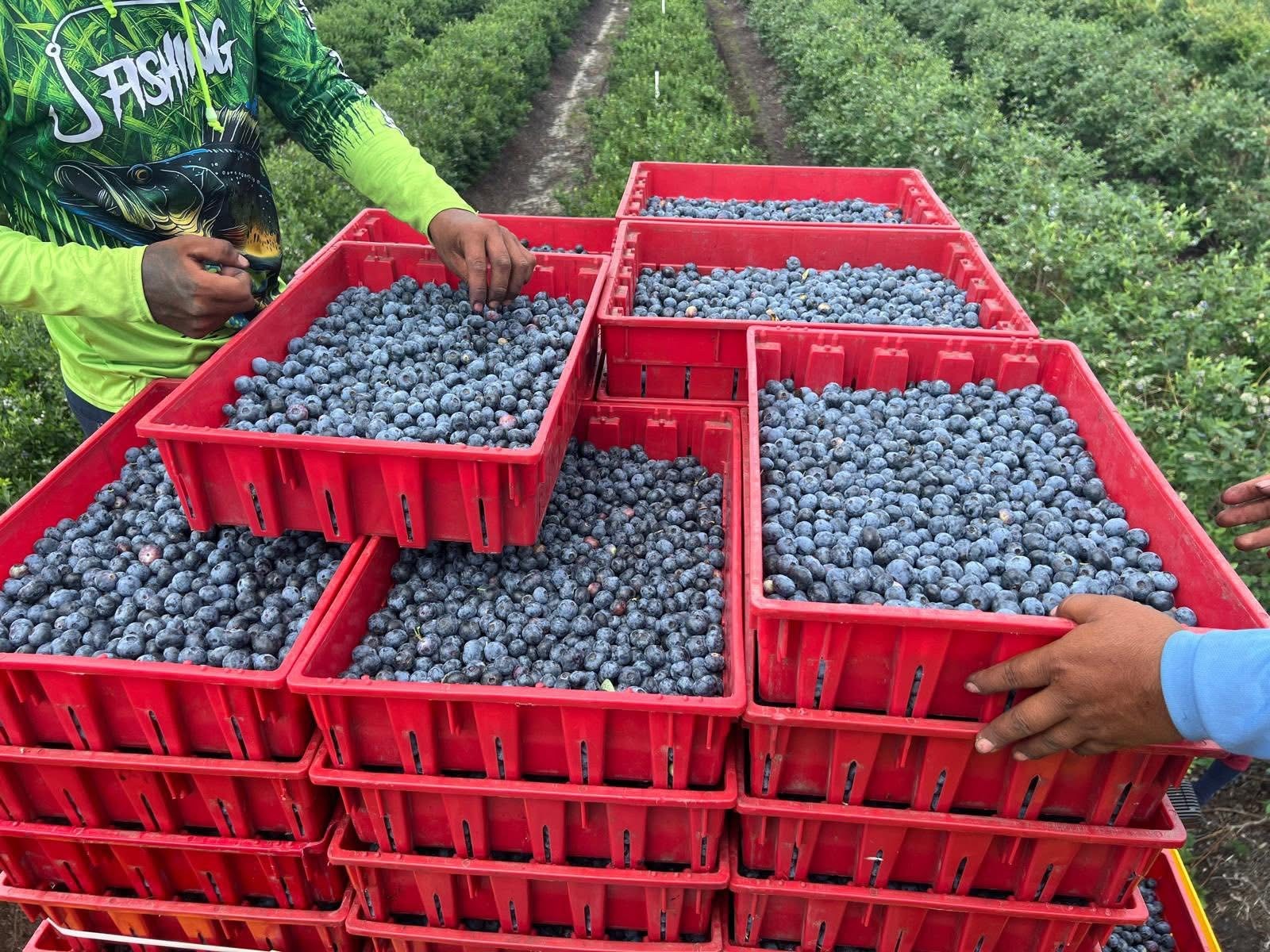
April 2026 blueberry harvest in Waldo, FL taken by Hays Harvesting driver, Jose Alberto Martinez Garcia
Plenty of farm labor contractors, she points out, still run on the same filing cabinets and binders they’ve had for 25 years, staffed by people who know exactly where everything is. “They feel like because they can touch it, they can see it, then that’s efficiency.” What it actually cost Hays Harvesting was the resource they had least of.
“It was a horrible use of our greatest asset, which is time.”
Payroll, compliance, and one place for everything
Payroll is where Lacey stepped in, and her description of the current process is almost anticlimactic: she pulls a single report from their timekeeping system and sends it over, Seso’s team prepares it and returns it for review, she approves it, and the checks come back ready to print. The checks and balances are deliberate, and she likes that they’re built in. “It’s a multi-step process, but they make it so easy, honestly.”
The relief runs deeper than hours saved, because compliance is the part that used to keep them up at night — whether deductions, reimbursements, and true income were all reflected correctly in payroll records and on check stubs.
It’s a conversation Anne Marie now has constantly with other FLCs and with growers who don’t use an integrated system or have the support of a knowledgeable, readily accessible agent. “So many times a day, I hear, well, I’m not real sure how we do that.“ Hays Harvesting can answer that question in specifics, which is the point. “We can speak to exactly the supports and scaffolds in place to ensure that we are compliant.”
When asked whether there was a particular moment she thought this saved me hours, Anne Marie doesn’t hesitate — “Oh, every day. Every day” — and lands on the reports and on having everything about a worker in one place. She looks around at the paper they kept for years simply because that was how it had always been done and jokes that what the office really needs is a bonfire. “But now we know better, so we do better.”
The value isn’t only in storage, though; it’s in being able to move through the data fast when something breaks, and something always does. “Every day is going to have its own fire. Every day is going to have its own emergency. So not only knowing where the data is, but how to access it is invaluable.”
When she doesn’t know how, she asks. “They may not be able to tell you that moment, but before it’s over, you’ll get guidance.”
“The magic is in the team”
Which brings her to the part of the answer she cares most about. Ask Anne Marie why Hays Harvesting chose Seso, and why they’ve stayed when cheaper options exist, and she goes somewhere other than the product.
Two or three months into the job she had decided the business might be worth saving, but she still had almost no idea how H-2A actually worked. “I had zero to no understanding what a petition was, much less how to get one out there.”
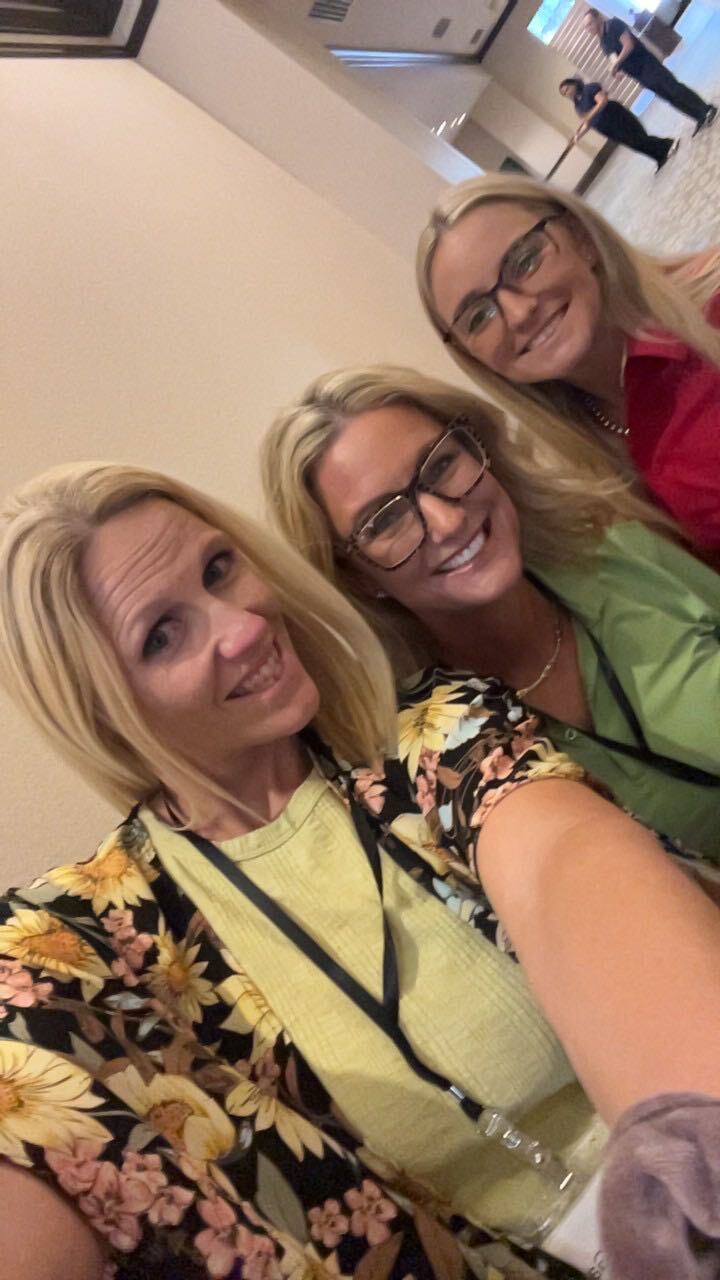
Anne Marie Hays and Lacey Nail with Seso's Melissa Garcia at FFVA Ag Labor Forum
Anne Marie was connected with Justin Littlejohn, then at Seso, and soon after with Dylan Katz. The call was scheduled for 30 minutes and ran an hour and fifteen. By the end of it she had turned to her mother, who was sitting also in the office, and said that if they were ever going to make this work, they needed these people.
What landed wasn’t a pitch. Justin said, “we can do this.” Dylan said, “we’ll figure it out”. And it wasn’t we’ll figure it out, if. It was a statement with no qualifier.
Dylan answered questions across time zones at every hour of the day. Dylan eventually gave way to Rachel, and then there was Barron, and Daniel, and Carolina, until the relationship had quietly become one of the closest in the business. “I think we talked to our team at Seso more than we talked to our other halves.”
Worth what you pay for
People ask her about the cost all the time — why spend it when someone will do it for less — and her answer surprises them.
“I wish I could tell you it was about the technology, because we love the technology. It’s not at all about the technology. It’s about the people. Seso may have a great product. But the magic is not in the technology. The magic is in the team that’s been assembled, in one place.”
She frames the decision in terms the industry already understands, because investment is the currency everyone in it deals in. Marketers and packing houses invest in the farmers; the farmers invest in their crews; and Hays invests in workers who show up at the expense of birthdays, holidays, and the births of their own children. “It’s all about investments — and your investment in Seso is exactly that. There will be a very visible, very measurable return.”
She has tested that conclusion more than once, too, because she thinks any company that stops checking is asking for trouble. “You’re remiss if you don’t continue to look at how your money’s spent. We’ve looked at other products. There’s not a comparison at this point.”
There’s one thing she especially wants smaller operations to hear, having worried about the budget herself at the start: size hasn’t changed how they’re treated. “I know there are much bigger companies out there. But you never feel like there’s some totem pole that you have to sit at the top or the bottom of.”
A ten-year view
Anne Marie now sits on Seso’s Customer Advisory Board as a founding member, and she’s clear-eyed about what she contributes. Others at the table bring an administrative or oversight perspective; she’s in the product every day. “We are in the trenches. We’re the people that really use the product.”
As for what comes next, last year offered an expensive lesson. Hays Harvesting took real risks in a season that brought a freeze Florida hadn’t seen in two decades, and the experience reset how Anne Marie measures the business. “It’s a misconception that whoever brings the most people, or whoever has the most growers, wins,” she says — and admits they had sipped some of that Kool-Aid themselves. What matters instead is doing the work as well as it can be done, holding the relationships, and knowing your margins exactly. It’s the discipline she watched her father practice for years.
“He didn’t care about being here next year. He cared about being here 10 years from now.”
That’s the version of success she wants: not the biggest numbers or the fastest expansion, but consistent, steady progress over time, in a company that stays recognizably the one her grandfather and her parents incorporated in 1983. “We want Hays Harvesting to be a company solidly founded and built on relationships. You do right by others, and good things will come to you. If you’re honest, and you truly care about what you’re doing and the people that are in the trenches with you, then success will come.”
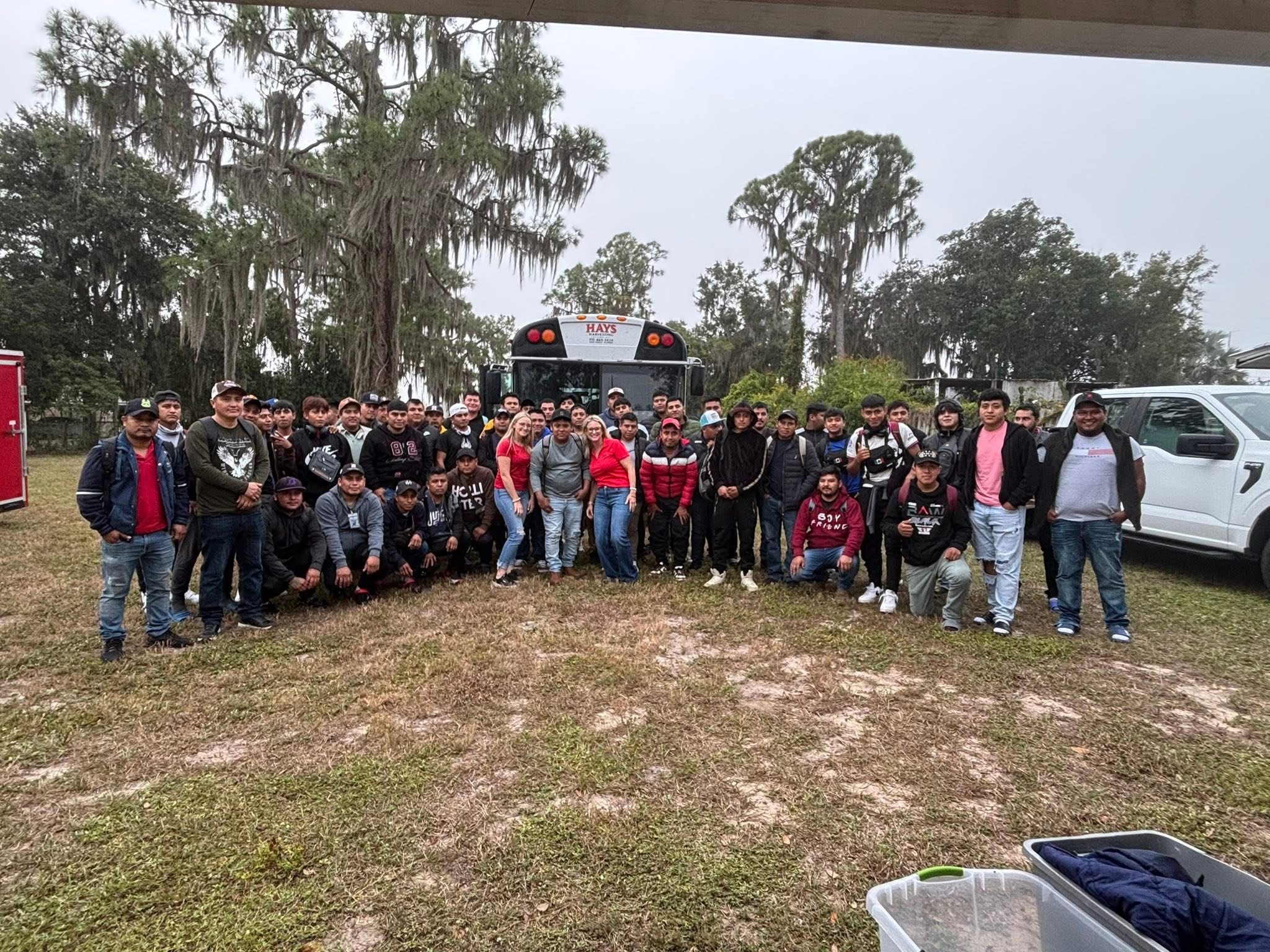
December 2025, following an orientation with some of the men that just arrived from Avon Park, FL
Curious what Seso could do for your operation? Get in touch — no matter your size.
Únete a las cientos de granjas y FLCs que apoyan a sus trabajadores con Seso